
First-ever: Overall Plagiarism of Medical Device Product Interface Design Determined as Unfair Competition — Unitalen Successfully Safeguarded Mindray's Rights
May 22, 2026Case Brief
Since its establishment in 1991, Mindray has been committed to the R&D and manufacturing of clinical medical devices. Starting with its flagship product — the patient monitors — Mindray has been dedicated to R&D for 30 years, consistently investing approximately 10% of its revenue in R&D. The core products produced by Mindray, such as the D6 defibrillator-monitor, N-series patient monitors, and SV-series ventilators (the "rights products involved"), were successively launched onto the market over more than a decade with hundreds of millions of yuan invested in R&D. Through continuous user research and iterative functional improvements, these products have achieved exceptional brand recognition and market share both domestically and internationally.
Through investigation, Mindray found that the user interfaces of multiple models of ventilators, patient monitors, and external defibrillator-monitors manufactured and sold by Comen are highly similar to those of Mindray's rights products involved in all elements, including color scheme, parameter layout, prompt information wording and layout, and operation key layout. The contents of the product manuals are also highly similar. Mindray contended that Comen has committed systematic, pervasive plagiarism across multiple products, from the product interfaces to the manuals, and accordingly filed a lawsuit to safeguard its legitimate rights and interests.
Regarding the alleged interface plagiarism behavior, the first instance court verified that the accused infringed interfaces one by one and determined that the accused infringing interfaces were highly similar to the corresponding interfaces of rights products in all elements, including color scheme, parameter layout, prompt information wording and layout, and operation key layout, constituting interfaces with basically identical designs. The court calculated the proportions of identical or similar interfaces in a way favorable to Comen: 25%, 43.8%, 48.4%, 33.7%, and 27.5%, respectively. The court ultimately determined that the similarity proportions between the accused product interfaces and the interfaces of the rights product exceeded the bounds of good faith and reasonable interface homogenization. Thus, the similar interfaces of the accused products constituted overall plagiarism of the corresponding interfaces of the rights products.
Examples:
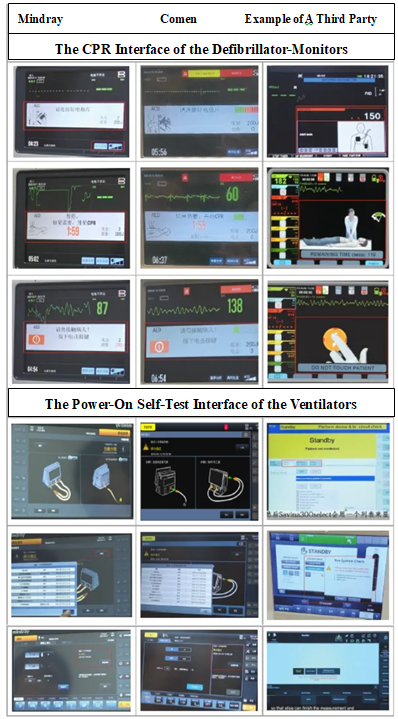
In respect of the plagiarism behavior on the manuals involved, the court of first instance commissioned the Guangdong Intellectual Property Protection Center to conduct an appraisal. Based on the statistical data in the appraisal opinion and after verifying and comparing the original text of the manuals, the court determined that the manuals for the five accused products, including the ventilators, external defibrillator-monitors, and patient monitors, were content-rich, with identical content accounting for 36.91%, 37.3%, 15.85%, 14.14%, and 10.71%, respectively, clearly exceeding the scope of good faith and reasonableness. The court accordingly determined that the five accused descriptions contained the same parts as the rights manuals and could be deemed plagiarism.
Ultimately, both the court of first instance and the court of second instance determined that the overall plagiarism behavior involving the interfaces of the accused models of ventilators, patient monitors, and defibrillator-monitors constituted unfair competition, and that the manuals constituted copyright infringement. The courts ordered Comen to cease the infringing behavior immediately. From the date the judgment took effect, Comen was prohibited from using the infringing manuals and interfaces in the accused products, including external defibrillator-monitors, patient monitors, and ventilators manufactured thereby.
Typical Significance
1. The court applied Article 2 of the Anti-Unfair Competition Law to afford overall protection to the medical device interfaces involved, providing a new approach for future rights protection of product user interfaces.
2. For a long time, the rights protection of the medical device industry has mainly focused on underlying technology or appearance design, with remedies relatively limited to patent rights protection, while the product user interface (UI) has long been in a vacuum of rights protection. The judgment in this case effectively fills this judicial gap, delineates clear boundaries for imitation in the behavior of medical device user interfaces, and indicates that industry regulation and patient safety should not be used as a shield for plagiarizing excellent original designs in the same industry. The case is of typical significance for the intellectual property protection of medical devices and even for the entire high-end manufacturing industry.
Keywords
Headquarters
Add(Beijing):7th Floor,Scitech Place,22 Jianguomenwai Avenue,Beijing 100004,China
Tel: +86 10 5920 8888
Fax: +86 10 5920 8588
E-mail: mail@unitalen.com
Newsletter
Do not miss out on the latest announcements we've provided
Networking



Unitalen Mail Box ©2016 Unitalen Attorneys at Law 版权所有 集佳知识产权代理有限公司 京ICP备11033076号 京公网安备11010502020670